Mielec, Poland: The Shtetl That Became a Nazi Concentration Camp by Saidel Rochelle
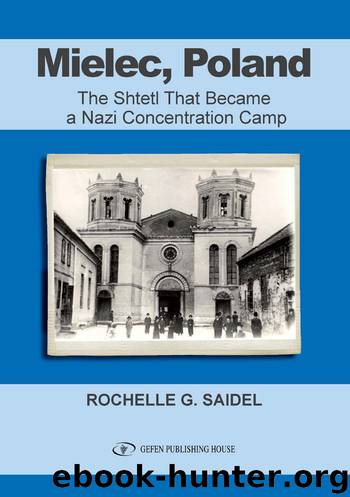
Author:Saidel, Rochelle [Saidel, Rochelle]
Language: eng
Format: epub
ISBN: 9789652295293
Publisher: Gefen Publishing
Published: 2012-01-01T00:00:00+00:00
Mr. Dobrowolski helped us to rent such a shelter in Złotniki, half a kilometer from Chrząstów, at the home of a peasant named Zak. My wife was put there with Mrs. Rozenzweig for 2,500 złotys per person. Without knowing it, we caused problems to another Jewish family, that of Markus Spalter. We had no idea that he was there with his wife and two children, paying much less. When Zak received 5,000 złotys for two people, he threw them out and then they had no shelter. They hid in the cornfield and were looking for some place to stay, but nobody wanted to take them.… Spalter was exhausted and begged Zak to take them back for a higher price. So he placed them in a hole dug in the barn. My wife and Mrs. Rozenzweig lived in a similar hole, 1.5 meters [5 ft.] wide and 1.5 meters deep.23
On August 4, 1944, the Russians entered Chrząstów and the Hönig family members were free and came out of hiding. By then the Dobrowolskis were impatient to see them go, Helen Hönig Schreiber recalled. “We left the village on foot, a group of eleven people. Walking slowly on feet grown swollen from sitting so long, and living on berries, we were going back, away from the village. The Russian soldiers threw us bread, American jam, and sardines,” she wrote.24 Returning to Mielec, they found a few friends who had survived, including Mark and Frieda Verstandig. Their house was occupied and Russian soldiers took them to headquarters in Kolbuszowa to arrange for housing. They then felt they were too near the front and moved to Rzeszów, where Frieda Verstandig had a bullet removed from her shoulder. Helen and the Verstandigs tried to return to Mielec but knew they could no longer live there and went instead to Lublin. Helen then returned to her parents in Rzeszów, and the family moved to Kraków. There Helen found her fiancé Henry, who had survived in Russia, and the family immigrated to the United States.25
Like the Hönig family, Sarah Blattberg-Cooper was also saved by the Dobrowolski brothers. When she heard rumors of the approaching March 9, 1942, Aktion, she decided to seek help from a Volksdeutsch acquaintance. She wrote:
Download
This site does not store any files on its server. We only index and link to content provided by other sites. Please contact the content providers to delete copyright contents if any and email us, we'll remove relevant links or contents immediately.
| Africa | Americas |
| Arctic & Antarctica | Asia |
| Australia & Oceania | Europe |
| Middle East | Russia |
| United States | World |
| Ancient Civilizations | Military |
| Historical Study & Educational Resources |
Cecilia; Or, Memoirs of an Heiress — Volume 1 by Fanny Burney(32558)
Cecilia; Or, Memoirs of an Heiress — Volume 2 by Fanny Burney(31956)
Cecilia; Or, Memoirs of an Heiress — Volume 3 by Fanny Burney(31942)
The Secret History by Donna Tartt(19090)
Sapiens: A Brief History of Humankind by Yuval Noah Harari(14389)
Leonardo da Vinci by Walter Isaacson(13336)
The Radium Girls by Kate Moore(12028)
Sapiens by Yuval Noah Harari(5372)
How Democracies Die by Steven Levitsky & Daniel Ziblatt(5219)
The Wind in My Hair by Masih Alinejad(5095)
Homo Deus: A Brief History of Tomorrow by Yuval Noah Harari(4918)
Endurance: Shackleton's Incredible Voyage by Alfred Lansing(4783)
Man's Search for Meaning by Viktor Frankl(4606)
The Silk Roads by Peter Frankopan(4534)
Millionaire: The Philanderer, Gambler, and Duelist Who Invented Modern Finance by Janet Gleeson(4478)
The Rape of Nanking by Iris Chang(4213)
Joan of Arc by Mary Gordon(4112)
The Motorcycle Diaries by Ernesto Che Guevara(4102)
Stalin by Stephen Kotkin(3968)
